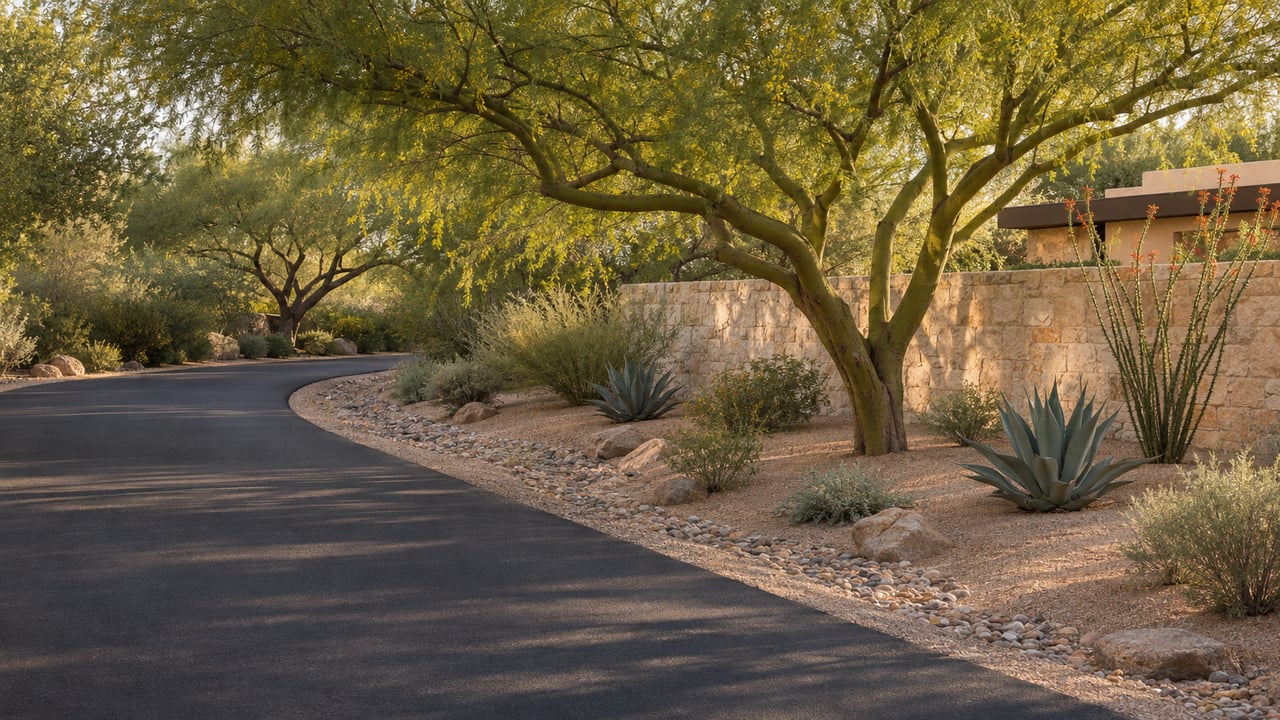
The intersection of Invergordon Road and Mockingbird Lane is closed this week. It has been closed since Oct. 26 for storm-drain work by Achen-Gardner Construction, and the town has scheduled it to reopen Nov. 23 if the weather cooperates, according to the Paradise Valley Independent. Four days after the closure began, three days of heavy rain dropped between 2.44 and 4.72 inches across town from Oct. 30 to Nov. 1. Public Works then logged nearly 150 debris locations and hauled more than 100 tons of material off town streets every day, according to the Town Manager's weekly update.
In the same week, Paradise Valley voters were deciding how much the town is allowed to spend on work like that. The town's budget is not short of money. Its limit comes from a formula written into the Arizona Constitution in 1980, and in the current fiscal year that formula had left the town less than half of one percent of room below its cap.
The Bill Paradise Valley Doesn't Send
The town assesses neither a primary nor a secondary property tax, according to its Resident Guide. The FY2027 tentative budget says the same thing in budget-form language. Paradise Valley "does not levy property taxes," so the state's property-tax schedule is left out entirely.
Instead, the money comes from activity. The Resident Guide lists resort sales and bed taxes, state-shared revenue, building-permit charges, utility franchise fees and investment interest. The tentative budget adopted April 23, 2026 puts numbers on that list for fiscal year 2026-27:
| General Fund source, FY2027 estimate | Amount | Share of General Fund |
|---|---|---|
| Transaction privilege tax | $37,678,398 | about 71% |
| State intergovernmental | $5,367,047 | about 10% |
| Permit and planning fees | $3,301,860 | about 6% |
| Fines and forfeitures | $2,354,100 | about 4% |
| Investment earnings | $1,973,567 | about 4% |
| Franchise fees | $1,502,349 | about 3% |
| Charges for services, rents and other | $787,600 | about 1% |
| Total General Fund | $52,964,921 |
Transaction privilege tax is Arizona's version of a sales tax. As of the Arizona Department of Revenue's rate table effective Jan. 1, 2026, Paradise Valley's retail rate is 2.5%. Its hotel classification carries a 2.5% rate plus a 3.4% additional hotel tax, for 5.9% in municipal tax on a room night. The town's resorts, its contractors and its visitors cover the costs a property tax pays for in most places.
A Ceiling Set in 1979-80
What the town may spend is set separately from what it collects. Arizona voters approved an expenditure limit for every city, county and town in 1980. The limit starts from what each town spent in fiscal year 1979-80, and the state Economic Estimates Commission adjusts that base each year for population and inflation. The town's publicity pamphlet for the Nov. 3 election describes it as "the maximum amount that the Town can spend each year, even if it has more money available to spend." Only spending is restricted. Revenue can grow without limit.
For fiscal year 2026-27, the tentative budget lists $48,055,234 of spending subject to the limit, against a limit of $48,281,082. That leaves $225,848, so roughly 99.5% of the allowance is already in use. The Economic Estimates Commission's final city and town table shows nearly the same limit, $48,281,821. The year before had less room still. In fiscal year 2025-26, spending subject to the limit and the limit itself were the same figure, $46,901,569.
Breaking the cap without voter approval has a price. State law would withhold the town's state-shared revenue, which came to $5,267,070 in fiscal year 2025, or 7.6% of the revenue used for town operations and infrastructure.
Why the Formula Undercounts This Town
The 1980 formula assumes that a town's costs grow with its headcount. Paradise Valley's pamphlet explains why that assumption breaks down there:
- The town's population grows very little, but its service load follows construction, both residential rebuilds and resorts that add rooms, renovate or open.
- Visitors and pass-through traffic from surrounding cities wear on roads, sewers, stormwater systems and public safety services without showing up in the population count.
- Many owners do not treat Paradise Valley as their primary residence, so the Census does not count them, yet they still use town services.
- Pension costs and construction costs, two of the town's largest expenses, have risen faster than the inflation measure the formula uses.
The same forces fill the revenue column. A resort renovation and a teardown on a one-acre lot both produce tax revenue, and both put demand on drains and streets. The formula counts neither. Since 1980 the town has also added sewer infrastructure, fire services, stormwater facilities, utility undergrounding and hillside development services, all under the same 1979-80 base.
The town has raised the cap before. Paradise Valley voters approved increases to the base in 2000, 2006 and 2016, and 84 of Arizona's 92 municipalities have modified their limits at least once.
What Voters Decided on Nov. 3
The ballot carried two separate measures.
Proposition 426 raises the town's 1979-80 base by $3,940,190. State law requires the amount to be stated in 1980 dollars, and it equals $20 million in current dollars. The pamphlet estimates the fiscal year 2027-28 limit at $51,702,050 under the old base and $71,702,050 with the adjustment. According to the town, the measure raises no taxes, does not require spending up to the cap and leaves the balanced-budget requirement unchanged. If it failed, the alternatives would be delaying infrastructure projects or issuing bonds. Bonds fall outside the limit but add interest costs.
Proposition 427 authorizes a Capital Projects Accumulation Fund. Once it is set up, the council could move surplus revenue from future years into it, and spending from the fund would not count against the cap. Money already in the General Fund balance cannot be moved into it. Only surpluses earned after approval qualify.
The pamphlet received no arguments against either measure. Mayor Mark Stanton's argument for Proposition 426 said the adjustment would let the town use revenue it already collects without raising taxes. Council member Anna Thomasson argued for Proposition 427 and stated in her submission that the town had generated $88 million in surplus revenue over five years. The pamphlet notes that submitted arguments are printed as written and not fact-checked.
These are the Maricopa County unofficial results posted Nov. 6 at 8:58 p.m., which remain subject to canvass:
| Measure | Yes | No | Yes share |
|---|---|---|---|
| Prop. 426, base adjustment | 4,156 | 2,867 | 59.18% |
| Prop. 427, capital fund | 4,427 | 2,557 | 63.39% |
The county listed 7,862 ballots cast in each contest, a turnout of 75.18%.
Where the Room Gets Spent
The town's FY2027-31 Capital Improvement Program totals $50,213,821 over five years, with $16,816,279 scheduled for fiscal year 2027. Most of it goes to the systems that matter on large, low-density lots. Ranked by size:
- Mockingbird Lane Storm Drain, 56th Street to Invergordon Road, $9,500,000, all of it in fiscal year 2027
- Upstream Cherokee Wash, $6,798,134
- SRP Underground Conversion at 40th Street and Lincoln Drive, $3,800,000
- Wastewater work totaling $3,665,000, split between a sewer-system assessment and repairs
- Mockingbird Lane roadway, 56th Street to Invergordon Road, $3,500,000
- Downstream Cherokee Wash, $2,999,716
- Lincoln Drive Storm Drain Improvements, Area O, $2,254,984
The largest item is the closed intersection at the top of this post. The council approved the final $68.7 million budget on May 14, with $15.9 million for capital improvements, and the Paradise Valley Independent named the Mockingbird Lane project in its coverage. Capital work is counted against the same cap as police, fire and street sweeping. That is why Proposition 427 separates it out. The pamphlet lists sewer repairs, drainage, power-line undergrounding, streets and intersections, and police and fire buildings as the kinds of projects the fund would cover.
More roadwork lands on the next two Thursday nights. The town has scheduled full signal shutdowns at Palo Cristi Road and Lincoln Drive from 7 p.m. Nov. 12 to 5 a.m. Nov. 13, and at Tatum Boulevard and Caida Del Sol Drive from 7 p.m. Nov. 19 to 5 a.m. Nov. 20.
What This Means for a Buyer
Paradise Valley pays for town services through hotel stays, retail sales and construction activity, so its income follows the resort calendar and the rebuild cycle. How quickly a wash gets rebuilt or a power line goes underground depends on a ceiling voters raised in 2000, 2006 and 2016 and, by this month's unofficial count, again on Nov. 3. On a one-acre lot, the drain at the end of the street and the condition of the arterial road out are part of what the house is worth.
The unofficial November results point to more room under that ceiling, and a dedicated fund for capital work, starting with the fiscal year 2027-28 budget cycle. When you review a specific street, check it against the CIP, because Mockingbird Lane, Cherokee Wash and the 40th Street and Lincoln undergrounding are scheduled projects with dollar amounts attached.
FAQ
Does Paradise Valley charge a town property tax? No. Both the town's Resident Guide and its FY2027 budget forms state that it levies no primary or secondary property tax. Other taxing jurisdictions may still appear on a county bill.
Did Proposition 426 raise taxes? According to the town's pamphlet, no. It raises the amount the town is allowed to spend, and the budget must still balance each year.
Are the November results final? As of the Nov. 6 county update, they are unofficial and remain subject to canvass.
This post is general information about public budgets and tax rules, not legal, tax or financial advice. Confirm how any of it applies to you with the appropriate professional.
If you want to look at a Paradise Valley property alongside the drainage, sewer and road projects planned near it, Charlie Yin can go through the town's capital plan for that address with you before you make an offer. Let's Connect.